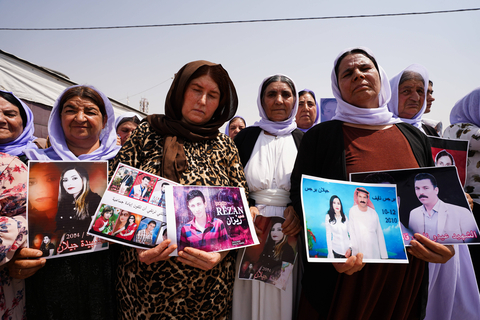
August 1, 2025, Zakho, Iraq: Iraqi Yazidi women hold pictures of their victims and missing relatives during a ceremony at Chamishko camp for Yazidi IDPs, in the Kurdistan Region of Iraq, marking the 11th anniversary of the Yazidi genocide. August 3 marks the 11th anniversary of the Yazidi genocide. On August 3, 2014,The Islamic State in Iraq and Syria (ISIS) committed a horrific massacre against the Yazidis in Sinjar, northwestern Iraq, killing men and abducting thousands of girls and women.
IMAGO / ZUMA Press Wire
In August 2014, ISIS militants moved from Mosul in northern Iraq to Sinjar and neighboring towns and villages, home to around 750,000 Yazidis. ISIS killed an estimated 5,000 Yazidis, primarily men and boys. They destroyed ancient cities, burned fields, and captured between 6,000 and 7,000 women and girls, whom ISIS enslaved and sexually abused for years. Following the defeat of ISIS, most of the women and girls were freed, but around 2,600 remain missing to this day. This genocide was not the first time the Yazidis were persecuted. As a religious minority spanning Northern Iraq, Syria, Turkey, and Iran, they had been persecuted for centuries. Their religious practices differ from Islam. They found refuge in the mountainous region of Sinjar, which provided them with some safety — until August 2014, that is. The mass killings carried out by ISIS members have been officially recognized as genocide by the United Nations.
From Victimhood to Agency: Yazidi survivors speak about their sufferings
In the aftermath of these atrocities, some Yazidi women bravely broke their silence. One of the first was Nadia Murad, who published a memoir recounting her captivity. Her story not only raised global awareness but also encouraged other women to come forward with their experiences, often encouraged by their male family members. These testimonies transformed narratives of genocide and sexual violence into stories of courage and activism. From being seen as victims of captivity and abuse, they began to see themselves as resilient survivors who took back their agency. They began speaking at international forums, publishing books, and advocating for justice—not only for themselves, but also for future generations.
DAK: Rebuilding Lives, One Woman at a Time
Rebuilding the lives of the survivors would not have been possible without the efforts of Yazidi civil society organizations—one of them, DAK, meaning “mother” in Kurdish. Founded by Yazidi women in 2014, DAK became a vital hub for women and girls affected by the genocide, providing survivors with mental health support, legal aid, and vocational training.
Yazidi women would have also found it difficult to recover without the support of key religious figures such as Baba Sheikh. Several activists, among them Sozan Safar and Farhan Ibraheem Ali, leader of the Youth Bridge organization from Sinjar, approached the religious authority to advocate for the survivors’ acceptance back into Yazidi society. Many women were initially seen as “tainted” due to forced conversions and sexual violence. Through symbolic purification rituals, survivors were welcomed back into the community. This marked a significant victory against deeply ingrained stigmas and helped rebuild trust and solidarity.
Legal Recognition: The Yazidi Survivor Law
DAK and Youth Bridge joined a broad movement of civil society and activists in pushing for legislative change regarding the Yazidi survivors in Iraq. On March 1, 2021, the Iraqi Parliament passed the Yazidi Survivor Law (YSL/ Law no. 8 of 2021), which offers reparations to survivors of the genocide, particularly for Yazidi women and girls, as well as other religious minorities who had suffered during the ISIS incursion. The law outlined the right to financial assistance, housing, mental and physical healthcare, and education. Article 7 of the law states that “crimes committed by Daesh against the Yazidis and other components (Turkmen, Christians, and Shabaks) shall be considered crimes of genocide and crimes against humanity.”
While the law is a significant milestone, its implementation remains inconsistent. In traditional societies, women often lack the legal rights to property, creating barriers for survivors returning to their ancestral lands. Many have no surviving male relatives to claim ownership. DAK successfully lobbied for legal reforms that enable women to own land—a transformative achievement for those hoping to rebuild their lives in their ancestral towns.
The Challenge of Returning Home
Despite these efforts, returning to Sinjar remains challenging. Much of the city is still in ruins. Infrastructure, such as water, electricity, and schools, is inadequate, and jobs are scarce.
But the biggest concern is security.
Survivors still feel unsafe in Sinjar, they feel ISIS members might still be there
says a DAK program officer. This fear discourages many women from seeking help, moving freely, or starting over. Some who initially returned to Sinjar ended up going back to displacement camps due to the harsh conditions and subjective perceptions of insecurity.
Life in Camps: A Generation in Limbo
In these camps, where thousands of Yazidis have lived for nearly a decade, a new generation is growing up without ever having seen a proper home. “Protection is not just food and shelter,” explains an activist.
It’s also about sustainable security and future perspectives—both of which are missing
Some years ago, NGOs such as DAK and Youth Bridge offered some education and vocational training, for example, in social work. Back then, women who participated in these trainings were still hopeful, but as the years passed by, hope diminished, and trauma festered.
Jan Ilhan Kizilhan, a German-Kurdish psychologist and trauma expert, who helped relocate Yazidi survivors to Germany in 2015, warns in an article in a German newspaper that the lack of positive future perspectives, such as education and employment opportunities, forces survivors’ memories to be locked in past traumas, undermining long-term recovery. Kizilhan calls this a “silent genocide” that endangers individuals’ ability to recover and live normal lives, erodes the social fabric, and poses a danger to the 4,000-year-old Yazidi culture itself.
The Mental Health Crisis and Rising Suicides
Suicide rates—especially among young women—are on the rise in camps. Many families do not report suicides due to shame. “We know it’s happening, but we don’t have exact numbers,” says the DAK staffer. Her NGO is among a number of initiatives that engage in advocacy campaigns to raise awareness of the risks of suicide as a form of prevention.
More concretely, they offer therapy programs and emergency interventions, such as a 24-hour suicide prevention hotline. However, many of these initiatives were severely impacted when USAID funding was cut during the Trump administration. Consequently, many NGOs had to reduce staff and scale back mental health services and other important programs.
The Forgotten Children: Born of Rape, Denied by Community
One of the most heartbreaking legacies of the genocide is the children born of rape. Because Yazidis doesn’t accept outsiders, especially those from different religious backgrounds, these children are rejected by the community because they are seen as bearing the identity of their ISIS fathers. “They’re just children,” says an NGO worker, “but communities can’t accept them—and you can’t force that acceptance.” Ghazala Elias Shvan of Youth Bridge adds:
Even the women don’t have a safe place to recover—how can they raise children whom everyone denies?
A project officer from YAZDA, an international NGO formed by Yazidi ex-patriates in response to the genocide, warns that many of these boys born out of rape were indoctrinated and pose a risk of radicalization. “We’re not talking about a few cases,” she says. “There are hundreds, maybe thousands.” Some Yazidi women tried to return to Sinjar with their children, but disappeared after facing rejection, most likely returning to refugee camps in Syria or Turkey. “The boys should have been placed in rehabilitation camps,” she concludes, “to reduce future threats of extremism.”
Seeds of Hope: Local NGOs Make a Difference
Despite the overwhelming challenges, Yazidi civil society organizations persist.
YAZDA works on documenting the crimes against humanity, identifying mass graves, and the destruction of cultural and religious heritage sites. Finding remains of those killed by ISIS at least provides some closure for the surviving family members, giving families answers they need to grieve.
Youth Bridge, the heartland of the Yazidi community, mostly active in Sinjar, works together with the community to create a positive outlook for the future of young Yazidis. In addition to rebuilding schools and community centers, they offer courses, sports, and vocational training to support youth.
These initiatives offer more than material aid. With the engagement of civil society organizations and dedicated activists and human rights defenders, those who were once victims, having managed to overcome the worst hardships imaginable, became survivors, regaining their agency and honor. Together, they started to rebuild their lives, communities, and society through healing, education, and activism for a better future.
The deep scars of the genocide are still felt until today, as it intends to destroy and erase an entire ethnic or religious group by killing its people, erasing its culture, and eradicating its future for generations to come. Ten years after the Yazidi genocide, the community continues to face displacement, collective trauma, and social exclusion, despite the distinguished work organizations are doing, and despite the legal recognition as crimes against humanity. The struggle for justice, healing, and restoration is far from over, and the wounds remain painfully open.