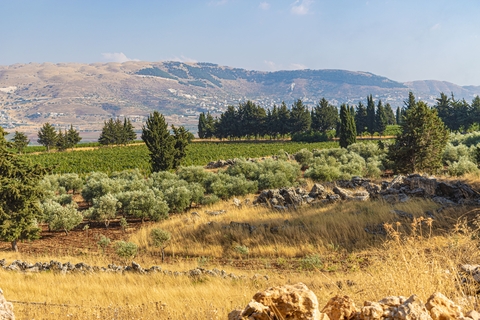
Overlooking the magical Bekaa Valley, The Bekaa Valley with farm lands and lakes located in Lebanon with a beautiful scenes and landscapes. IMAGO / Dreamstime
Executive Summary
The 2024 war between Israel and Hezbollah has pushed Lebanon’s already vulnerable agricultural sector into an unprecedented crisis. Based on field interviews, government data, and satellite assessments, this report documents the widespread destruction of crops, infrastructure, and livelihoods across southern Lebanon and beyond.
Key Findings
- Farmer Displacement & Access Loss: Over 36,000 farmers were affected, with 71% unable to access their lands due to conflict or restrictions. Many lost entire harvests and equipment.
- Crop & Sectoral Damage:
- Olive trees suffered the most damage (57%), followed by fruit trees/grapevines (37%), and field crops and poultry (30%).
- Livestock losses exceeded 1 million chickens and 12,000 animals, with beekeeping, nurseries, and greenhouses also devastated.
- Environmental Hazards:
The confirmed use of white phosphorus (WP) has caused long-term soil and water contamination, particularly in the south, destroying over 60,000 olive trees and rendering thousands of hectares unusable. - Infrastructure Collapse:
Water systems, solar-powered irrigation, and electricity grids were systematically damaged, with losses estimated at $400 million in infrastructure alone. - Market Breakdown & Food Security:
Local markets have been destabilized by crop shortages, driving up food prices. Exports, especially to Syria and the Arab region, have stalled, compounding economic strain. - Community Collapse:
Entire villages have been destroyed—homes, mosques, schools, and farmland alike—leaving many farmers with no shelter, income, or path to recovery.
Recommendations
- Urgent Damage Assessment & Compensation: Prioritize rapid surveys and cash/technical aid for affected farmers.
- Rebuild Critical Infrastructure: Focus on irrigation, electricity, and solar systems to restart cultivation.
- Environmental Remediation: Launch targeted programs to detoxify WP-contaminated soil and water sources.
- Support Smallholders: Distribute livestock, seeds, equipment, and low-interest credit to restart production.
- Reopen Export Channels: Reinforce regional trade links and leverage diaspora markets.
- Invest in Rural Recovery: Reconstruct homes and public services to enable displaced farmers to return.
Abstract:
The war between Israel and Hezbollah, which escalated dramatically across southern Lebanon in September 2024, has pushed Lebanon’s already-fragile agricultural sector into a state of unprecedented crisis. This report, based on extensive field interviews with farmers, municipal leaders, and agrarian union heads, as well as official data from the Lebanese Ministry of Agriculture and international organizations, provides a comprehensive account of the damage sustained by Lebanon’s farming communities.
Employing a mixed-methods approach that combines qualitative interviews with key stakeholders and an analysis of open-source data gathered from October to December 2024, this report documents the destruction of farmland, irrigation systems, and the systematic uprooting of tens of thousands of ancient olive trees. It also highlights long-term environmental and health hazards associated with white phosphorus munitions, as confirmed by scientific assessments. Over 36,000 farmers have been directly or indirectly affected, with many unable to access their lands or salvage their harvests. Damage estimates exceed $3 billion.
Findings reveal how the war exacerbated an already dire economic reality for Lebanese farmers, many of whom were struggling due to inflation, infrastructure decay, and dwindling state support. This report aims to illuminate not only the losses of crops and livestock but also the losses of entire communities and their ways of life.
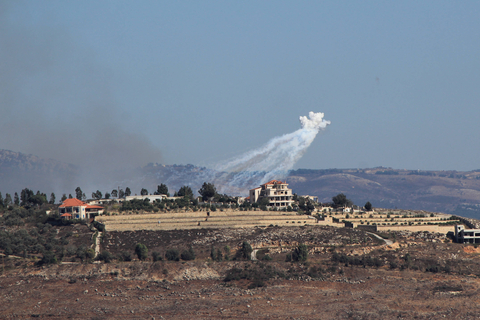
This photo shows the smoke from Israeli phosphorus shells in Khiam, Lebanon, on Sept. 11, 2024. Two civilians were killed and one was injured on Wednesday evening in an Israeli airstrike on southern Lebanon. IMAGO / Xinhua
Introduction: The Scale of Agricultural Devastation
"Imagine trees you planted and nurtured for 25 years—trees you cared for like your own children. They became an essential part of your life, providing food, shelter, and education for your family. Some of these trees are over 300 years old, having been passed down through generations. In the blink of an eye, a single year of war burned them, uprooted them, and erased them forever. Twenty-five years of hard work and dedication were lost in an instant," says Ali Abu Samra, the “Mukhtar” (local leader/mayor) of Dhaira, a border town in southern Lebanon.
Abu Samra felt a brief sense of relief when he returned to his village after the war and found a few olive trees still standing. But his hopes quickly dwindled. Just days later, an Israeli military patrol returned to the village with bulldozers and uprooted every remaining tree.
Not a single olive tree was left standing in the entire village. Over 50,000 trees were damaged or destroyed. It’s as if they don’t want any life to remain here; as if they want no one to return to farming
The scene across the southeastern borders is similar. Abdou Hashem, a resident of Shebaa, has been living in constant worry about his orchards and agricultural projects. “For about 2 years, I have been unable to visit or check on them,” he says.
Dozens of villages between Dhaira and Shebaa line Lebanon’s southern border with the Occupied Palestinian Territories, otherwise known as Israel, all of which share the same struggles, fears, and realities. The war and the subsequent destruction have stripped these villages of their identity, reducing them to piles of rubble and severely affecting different aspects of local and national life. Among the hardest-hit sectors is agriculture, a backbone of the local Lebanese economy and a critical source of livelihood for rural communities. Before the war, this sector had been semi-neglected, weakened by the 2019 economic crisis, limited financial access, poor value chain integration, and inefficient public institutions. The recent conflict has inflicted severe damage, with estimated losses exceeding $700 million according to a report released by the Food and Agriculture Organization (FAO) and Lebanese authorities1. The destruction of crops, livestock, and agricultural infrastructure, as well as the contamination of land, has further exacerbated the sector’s decline, threatening the livelihoods of rural populations and Lebanon’s food security.
Pre-War Challenges: Agriculture on the Brink
Lebanon’s agricultural sector has borne the brunt of the country’s political and security turmoil for decades. The economic collapse of 2019, described by the World Bank as “one of the most severe crisis episodes globally since the mid-nineteenth century,” further devastated farmers. The Lebanese pound’s collapse led to a significant increase in production costs, with the prices of fertilizers, seeds, pesticides, and other essential inputs doubling or tripling.
Simultaneously, surging fuel and electricity costs, essential for irrigation, storage, and transportation, crippled agricultural operations.
To cope with rising costs, farmers increased prices, which reduced their competitiveness in local and international markets. Crop yields reportedly declined by 20% to 50%, further undermining economic sustainability.
Additionally, decades of neglect left rural infrastructure—irrigation networks and roads—in disrepair, hindering production and transport. As local output declined, Lebanon became increasingly reliant on food imports, thereby increasing its vulnerability to external shocks and national food security risks.
Tens of Thousands of Farmers Trapped in Post-War Limbo
The war and its aftermath have plunged Lebanon’s already fragile agricultural sector into its darkest period in modern history.
According to Ibrahim Tarshishi, head of the Farmers' Association and a spokesperson for the Ministry of Agriculture (MoA), "We lived through dark days during the war, never knowing if we would survive to see the next morning." Yet, he explains, the post-war reality has proven to be even more challenging, as farmers face destroyed livelihoods that threaten their ability to continue the work passed down through generations.
While the MoA has yet to finalize a complete damage assessment due to ongoing military operations along the Lebanese-Israeli border, its digital platform, launched in December, shows that around 36,000 farmers across Lebanon have been directly or indirectly affected. Directly affected farmers have suffered total crop losses due to destroyed or burned lands and orchards, while indirectly affected farmers have been unable to harvest due to blockades or restricted access to their fields, leading to crop spoilage despite minimal physical damage to the land. Data from the platform reveal that 71% of registered farmers were unable to access their lands or harvest crops, reflecting the severity of the crisis. The remaining 29% suffered direct structural and agricultural damage to their lands.

Personal stories bring these statistics to life. In Shebaa, Mukhtar Hashem is among many farmers who have yet to assess the damage to their lands fully. For two years, he has been unable to visit his orchard in the valley, which contains cherry, apple, peach, and pear trees. "All my crops there have been destroyed," he says. "My second plot of land near the river also suffered severe damage from the shelling."
Mukhtar Hashem also painfully tells the story of his olive grove, which he nurtured for 20 years:
haven’t harvested a single olive in two years. This reflects the situation across the region; no farmer has been able to collect their crops. The shelling and phosphorus wiped out everything
Preliminary data from the MoA reveal that the olive sector took the most significant blow, accounting for 57% of total crop damage, followed by fruit trees and grapevines at 37%, and field crops and poultry each suffering 30% damage.

Sectoral Losses: Beyond Olive Groves
In a private interview, Tarshishi highlighted the particularly devastating losses to fruit trees: "If these trees go without water for a year, the damage becomes permanent. Farmers must replant and wait years for the trees to start producing fruit again. This problem affects southern Lebanon and the Bekaa Valley alike."
Other sectors have also been hit hard: livestock losses are estimated at 23%, whole grain and legume crops declined by 20%, beekeeping was affected by 17%, and damage to greenhouses reached 7%. Nurseries and agricultural inputs—such as fertilizers and equipment—were damaged at a rate of 6% each. Many farming families operate mixed-use farms, meaning damage often overlaps across sectors.

In Dhaira, Mukhtar Abu Samra estimates his losses, including those from farms and agricultural investments, at around $500,000. His village, once thriving with year-round cultivation of grains, vegetables, and fruits, has seen everything wiped out in just 18 months.
Everyone here is a farmer—there is no other source of income. Every household owns various types of farming equipment, ranging from engines and sprayers to plowing machines. In our village alone, we lost around 20 tractors. Everything was destroyed—there’s nothing left, not even the beehives
Small-scale farmers have been particularly devastated, with many forced to sell their equipment to survive. According to Tarshishi, these farmers "have been left broken and humiliated in their own homes and lands, with no support from the state or international organizations.”
Documented Damage across the Country
The recent conflict has inflicted significant damage on Lebanon’s agricultural and natural landscapes. According to the MoA and the National Council for Scientific Research (CNRS), the destruction has been both widespread and severe, with certain regions suffering near-total losses.
National Overview:
- Woodlands were the most brutal hit, with 55% damaged.
- Land cultivated with fruit trees—including olives and citrus—saw 35% destruction.
- Grasslands and natural vegetation were 10% affected.
- Over 322 hectares of land were burned entirely, while a total of 7,200 hectares of agricultural and natural land, including woodlands and cultivated areas, suffered either total or partial damage.
- More than 60,000 ancient olive trees were destroyed, and 200 hectares of agricultural greenhouses were rendered unusable.
Regional Impact:
The scale and intensity of destruction varied significantly across Lebanon:
- In Nabatieh Governorate and Hermel, 100% of villages were affected entirely.
- The Bekaa region saw damage in 50% of its villages
- Other regions experienced relatively less, but still significant devastation.
Crop Damage by District (2022 Satellite Data)
Using satellite imagery from 2022, the CNRS highlighted several impacts faced by the agricultural sector and crops, particularly in southern Lebanon. The findings revealed heavy losses in Hasbaya, Marjayoun, Tyre, Bint Jbeil, and Nabatieh.
District | Fruit Trees | Olive | Vineyards | Citrus | Crops | Greenhouses | Banana |
Bint Jbeil | 100% | 100% | - | - | - | - | 100% |
Marjayoun | 100% | - | 100% | - | - | 64-95% | - |
Tyre | - | - | 100% | - | - | 64-95% | - |
Hasbaya | 64% | 35% | 100% | 100% | 73% | - | - |
Sidon (Saida) | 23% | 28% | 28% | 33% | 45% | 46% | - |
Western Bekaa & Rashaya | 4% | - | - | - | - | - | - |
Baalbek | - | 32% | - | - | - | - | - |
Key Observations:
- Total Destruction Zones:
Bint Jbeil experienced a 100% loss of bananas, olives, and fruit trees, indicating a complete agricultural collapse. - Vineyard Devastation:
Marjayoun and Tyre experienced a 100% loss of vineyards, which is critical for Lebanon's wine production. - White Phosphorus Impact:
Hasbaya's 100% citrus loss and 73% field crop damage are correlated with confirmed white phosphorus use, resulting in long-term soil toxicity. - Bekaa Valley:
While Western Bekaa experienced minimal damage (4% of fruit trees), the broader Bekaa region faced approximately 50% production loss due to disrupted supply chains and shelling.
Contextual Analysis:
- Economic Impact: Southern Lebanon contributes 38% of national olive production and 22% of citrus, with agriculture representing 80% of local GDP. The USD 704 million total damage (FAO 2025) exacerbates pre-existing economic crises.2
- Environmental Legacy: 5.14 million m² of land scorched by white phosphorus will require decades of remediation, affecting future food security.3
- Displacement Effect: 63% of farmers couldn't access fields, and 26% abandoned lands entirely, disrupting generational farming practices
Losses in the Livestock Sector
The livestock sector has been among the most brutally hit during the recent war, suffering unprecedented damage that has pushed this vital industry toward near-collapse in several areas.
In Shebaa, Mukhtar Hashem describes the extent of the destruction: "I had 37 chickens, but when I returned, only a few were left. The others were either lost or dead. Milk and poultry production came to a halt entirely, and many were forced to sell part of their livestock to preserve what was left. The livestock sector in Lebanon is collapsing, and no one is taking action to save it."
Similarly, in Dhaira, Mukhtar Abu Samra recounts a similar story of devastation: "We were forced to leave the village and couldn’t return to retrieve anything. We lost approximately 70 to 80 head of cattle out of a total of 100 cattle in the entire village. Nearly all sheep and goats died. Some people managed to move a few cows to safety in Sidon, but during the 66-day war, they had to abandon them there and never saw them again."
The Lebanese Ministry of Agriculture estimates:
- Over 1 million chickens lost.
- Approximately 12,000 heads of livestock were killed.
- destruction of 5,200 beehives, with partial damage to an additional 20,000 hives.
- Destruction of feed warehouses covering over 10,000 square meters.
- Severe damage to fodder crops, causing acute shortages in animal feed supply.
The conflict coincided with the breeding season, severely impacting sheep and goat births and milk production. Beekeeping has suffered drastically—many beekeepers who once managed 50–60 hives now have only one or two weak hives, insufficient for honey production. This decline directly affects food security, as many beekeepers rely on honey sales for basic household expenses.
Damage to Agricultural Infrastructure
The recent war has severely damaged essential agricultural infrastructure, particularly water and electricity networks, crippling Lebanon’s agricultural sector and compounding the existing economic crisis.
Water and Electricity Infrastructure
Lebanon’s Minister of Energy and Water estimates losses of around $400 million. Damaged facilities include over 30 water treatment plants and widespread destruction of electricity grids. Issues include:
- Water treatment plant and pipeline damage are disrupting access to clean water.
- Investment in infrastructure for water supply in southern Lebanon was severely affected.
- Repeated airstrikes have directly damaged water and electricity networks.
- Severe water shortages due to disrupted collection and distribution.
Destruction of Solar Power Systems
Solar power systems, critical for irrigation in the face of national grid failure, were heavily damaged. Initial estimates suggest hundreds of solar installations were fully or partially destroyed, halting irrigation over thousands of hectares.
Farmers have lost millions in solar investments, which had offered hope of reducing energy costs and sustaining irrigation.
White Phosphorus: A Long-Term Agricultural Disaster
White phosphorus (WP) is a highly reactive chemical used in warfare to create smoke screens, but its deployment in agricultural areas has caused devastating environmental and health consequences. When WP ignites upon contact with air, it releases phosphoric acid that contaminates soil and water, leading to wilting crops, reduced soil fertility, and accelerated erosion. This contamination can persist for decades, requiring costly rehabilitation efforts to restore ecosystems and protect food security.
A study by the American University of Beirut (AUB) confirmed the repeated use of WP munitions in Lebanon during 2024, describing it as a “recurring phenomenon.” The CNRS assessed fire severity caused by Israeli aggression between October and November 2023. Furthermore, the Ministry of Environment registered hundreds of hectares of farmland and forests destroyed, as well as approximately 40,000 ancient olive trees burned due to WP exposure.
The study describes how WP contamination spreads through rivers and groundwater, polluting irrigation water and making crops unsafe for consumption. The resulting eutrophication disrupts ecosystems and further reduces agricultural productivity. The long-term environmental damage threatens the viability of Lebanon’s agricultural sector, particularly in the south, necessitating expensive ecological rehabilitation.
The Tobacco Sector: A Case Study of Collapse Amid Environmental and Conflict Pressures
Tobacco cultivation in South Lebanon is more than just an agricultural activity; it is a historic livelihood that supports thousands of families and entire villages. Traditionally, tobacco farming covers approximately 90,000 dunums (9,000 hectares) and supports around 15,000 to 16,000 families, with nearly 60% of local southern farmers relying on tobacco as their primary source of income.
However, the tobacco sector has been severely impacted by the conflict and WP contamination. According to the MoA’s 2024 data, tobacco fields showed only 2% damage, not because they escaped harm, but because most farmers failed to plant crops in spring 2024 due to ongoing hostilities. Tobacco cultivation had already come to a near standstill before the outbreak of the full-scale hostilities in September 2024. Production plummeted from a typical 5 million kilograms annually to under 2 million kilograms in 2023-2024, as many farmers abandoned remote fields and limited cultivation to areas near their homes to reduce losses. For example, in Aitaroun village, only two out of 900 registered tobacco farmers managed to plant in 2024, illustrating the severity of the crisis.
The most alarming threat is the contamination of nearly 80% of tobacco fields with white phosphorus, which degrades soil fertility and pollutes crops, undermining the sector’s recovery for years.
Impact on Local Markets and Food Security
The ongoing agricultural crisis has immediate effects on local markets, threatening shortages of essential products in the coming months. In southern Lebanon, honey production is expected to suffer significantly due to massive losses in the beekeeping sector. Likewise, the olive industry has suffered a significant setback, with many farmers unable to harvest or press their olives. This has led to a notable absence of olive oil in local markets, a significant blow given its vital role in Lebanon's local economy and cultural heritage.
This severe crop shortage has directly affected local markets, where staple products such as olives, pickled vegetables, and traditional homemade provisions (moune) have become scarce and expensive, impacting citizens' ability to meet their basic needs.
This shortage of key crops has driven up prices for staple products, such as olives, pickled vegetables, and traditional homemade provisions (moune), making them scarce and increasingly unaffordable for many citizens.
This spike in prices was inevitable under such circumstances. Mukhtar of Shebaa, Abdou Hashem, highlights the distressing reality faced by local markets
Prices have skyrocketed. A can of olive oil that I used to sell at an affordable price now costs me $125 to purchase, even though I once produced it from my land at no additional cost. Markets are paralyzed, and those who still have limited production either sell at a loss or can’t find buyers. People are struggling, and no one seems to care
This combination of reduced supply and soaring prices has further strained Lebanon’s fragile food security, leaving farmers and consumers alike in deep uncertainty.
Export Disruption and Its Impact on Foreign Markets
The export of bananas and citrus fruits to Syria came to a complete halt with the outbreak of the war, severely affecting Lebanon’s agricultural sector, which had long depended on this critical market. Syria serves as the only land corridor of Lebanese farm exports to neighboring Arab countries such as Iraq, Jordan, and the Gulf states, making this disruption particularly damaging.
However, the war is not the sole factor behind the export challenges. Ongoing political crises, particularly the prolonged Syrian conflict and its aftermath, have long hindered export activity and reduced the number of accessible external markets for Lebanese farmers. Recent developments following the fall of the Syrian regime have further complicated the situation, creating uncertainty over border status and the future of cross-border trade and transit routes.
Despite these obstacles, the Lebanese agricultural market continues to rely on domestic sales and exports to Arab countries, Africa, and occasionally to Europe and the United States, often facilitated through Lebanese diaspora networks. While the current suspension of exports via Syria may not result in a permanent loss of these markets, it has immediate consequences for farmers who are struggling to sell their produce.
Nevertheless, some agricultural sectors are showing signs of gradual recovery. Ibrahim Tarshishi, president of the Farmers’ Association, expressed cautious optimism: "Banana farmers have resumed production and exports. Citrus fruits remain available in local markets, and Lebanese avocados have become a standout product in the Middle East, exported in large quantities. This recovery offers hope for farmers to regain part of their agricultural activity."
Impact of Agricultural Losses on Livelihoods and Communities
The ongoing conflict, along with Lebanon’s prolonged economic crisis, has dealt a severe blow to agriculture and the livelihoods of farmers nationwide. Many who managed to harvest their crops found it nearly impossible to sell them, as the downturn has drastically eroded local purchasing power. In the Bekaa Valley, crops such as grapevines, wheat, and especially potatoes suffered significant setbacks. The potato harvest coincided with the peak of the crisis. Without timely collection and care, losses mounted steeply—planting costs alone ranged from $600 to $800 per 1,000 square meters, pushing many producers deeper into hardship.
The shortage of agricultural labor has further compounded these losses. With few workers available, crops requiring daily attention—like cucumbers and tomatoes—quickly spoiled and became unsellable. Transportation limitations, due to ongoing instability and restricted movement, added another layer of challenge. Even successful harvests often had to be sold at a loss, making meaningful recovery nearly impossible.
Such uneven damage across regions reflects the varying intensity of attacks, with border regions most severely impacted. Yet, the effects have rippled nationwide, damaging fundamental infrastructure and threatening to paralyze a sector that forms a cornerstone of Lebanon’s economy.
For countless farmers, these losses go beyond crops and livestock. In heavily affected border areas, many have lost not just their fields, but also their homes and communities. Recovery now depends on rebuilding housing and restoring essential services. As one local leader starkly puts it:
We don’t have a single intact house left. In the entire village—about 440 houses—not one was spared destruction. Three mosques, a large school, the municipal building: all wiped out
Returning to farming under such conditions is daunting. “If a farmer returns to Al-Dhaira today, what can he do? There’s no infrastructure, no homes standing. Crops need years to recover, and people abandoned their homes long ago. It will take twenty years for the trees to return to what they were,” says Mukhtar Ali Abu Samra. Another farmer, Hashem, agrees: “It will take three or four years to rebuild and fully rehabilitate the area.” Both recall that the 2006 war was minor by comparison: “Back then, the damage did not exceed 1%. Today, 100% of our properties have been partially or completely devastated.”
Frustration has deepened among those still awaiting compensation for losses suffered in the 2006 war. The slow response then leaves many skeptical about the prospect of support this time.
The Struggle to Revive Lebanon’s Agricultural Sector and the Urgent Need for Support
Lebanon’s agricultural sector is at a crossroads. Despite the magnitude of the crisis, neither the government nor international organizations have delivered significant aid. Without a comprehensive recovery plan or updated damage assessments, many farmers—especially those growing short-cycle crops—remain uncompensated and unable to restore their livelihoods. They face the dual challenge of rebuilding lost capital and replacing essential tools, all while struggling to repair irrigation systems crucial for future harvests.
The ongoing energy crisis makes support for renewable energy solutions, such as solar and wind power, more critical than ever. With high fuel costs and unreliable electricity, these alternatives could dramatically reduce operational expenses for irrigation-dependent farms. Without such interventions, many may be forced to abandon their land permanently, endangering not only their own survival but also Lebanon’s broader food security.
The outlook in border villages is especially grim. Homes are ruined, infrastructure lies beneath rubble, and entire plots of land have been bulldozed. Rebuilding is a massive undertaking—simply constructing a small house now costs at least $500,000. Community leaders stress that expatriate support is not enough; those without overseas family must fend for themselves. The destruction of vital networks, like irrigation and power, further hinders recovery. Without international donor support and a clear government strategy, reconstruction remains a distant goal.
Despite these immense obstacles, some farmers remain committed to their land, holding onto hope for effective aid and substantive change.
The Path Forward
There is a broad consensus that the sector’s survival depends on:
- Comprehensive compensation and recovery programs
- Reviving institutions like the Agricultural Credit Bank
- Provision of low-interest loans for renewable energy equipment
- Support for small farmers, including livestock distribution
- Efforts to reopen export markets for Lebanese produce
As Mukhtar Hashem puts it: “There’s a chance to revive the sector if cooperatives get real support. We need new tractors, new seedlings, and the ability to export again. But the Lebanese farmer, though resilient, cannot survive alone. Without help, people will abandon their land, and nothing will be left to hold on to.”
Local uncertainty is palpable. “Many have sold their land and given up farming. Here, investing in agriculture is a major risk. No one knows what’s next. Our community depends on farming—if it collapses, there will be nothing left to sustain us. People are exhausted, and patience has limits. Many now believe the sector is finished.”
Lebanon’s agricultural future hangs in the balance. Without rapid, coordinated action and a clear recovery plan, the collapse of agriculture will not only devastate farmers but also erode national food security and cause lasting harm to rural communities for years to come.
Conclusion
Lebanon’s agricultural sector has suffered catastrophic losses due to a combination of conflict, economic crisis, and structural vulnerabilities. The widespread destruction of crops, livestock, and essential infrastructure—exacerbated by environmental contamination from white phosphorus—has severely undermined both farmers’ livelihoods and the country’s overall food security. Many rural communities face not only the loss of fields and equipment but also damaged homes and devastated local services, making recovery a daunting challenge.
Despite the scale of the crisis, government and international support remain insufficient, with incomplete damage assessments and compensation efforts leaving many farmers deprived of aid. Without urgent intervention, the sector risks further decline, threatening Lebanon’s socio-economic stability for years to come.
Key Recommendations
A comprehensive recovery requires immediate focus on assessment, compensation, and rebuilding. Transparent and thorough damage evaluations are crucial for fairly compensating affected farmers, particularly those who rely on short-term crops. Financial and technical assistance must enable smallholders to replace lost equipment, restock livestock, and secure quality seedlings.
Simultaneously, restoring critical infrastructure—especially irrigation, water supply, and electricity networks, including solar-powered systems—is vital to resume productive farming. Environmental remediation to address soil and water pollution from conflict munitions should also be prioritized to protect agricultural viability and public health.
To revive market opportunities and support economic resilience, reopening export channels and strengthening cooperative models will improve farmers’ competitiveness and income streams. Given Lebanon’s energy challenges, accelerating the adoption of renewable energy technologies will help reduce operating costs and reliance on unstable fuel supplies.
Lastly, rebuilding must extend beyond agriculture itself by investing in rural housing and essential services, enabling displaced farmers to return and rebuild their communities. Effective recovery hinges on coordinated policies that engage government, international partners, civil society, and farmers, aligning with Lebanon’s National Agriculture Strategy for sustainable growth.