IMAGO / Xinhua
When the Assad regime rapidly collapsed in December 2024 after more than ten years of bloody war, euphoria spread among the many Syrians who had suffered under its ruthless rule. The horrors of Saydnaya prison1 in particular were broadcasted to the world and reminded everyone just how sadistic the regime had been. But while some voiced skepticism about whether Syria’s new Islamist rulers would build an inclusive state for all of its diverse communities, the political establishment of the EU and USA was quick to move towards normalization of relations with the new authorities. The series of massacres against the Alawites of the Syrian coast in early March that left between 800 and 1,476 civilians dead and the lack of accountability for any of its perpetrators have not resulted in any revision of this process.
Warning signs of a pogrom-to-come were there much earlier than March. According to the Syrian Observatory of Human Rights, at least 148 Alawites were killed in December 2024 alone. This did not stop the German and French foreign ministers from meeting with interim President Ahmad ash-Shara’a on January 3, where Baerbock stated that there could only be a new start if justice was implemented and no acts of revenge were carried out. In fact, this earlier downplay of rising violence against the Alawite community may have reduced the fear of consequences. On January 23, residents of the village of Fahil west of Homs reported an attack by gunmen that left 58 dead, with two more victims in the neighboring Maryamayn, according to journalist Jenan Moussa. In addition, reports talked about numerous civilians being beaten and religious symbols vandalized in the two villages. Due to the insecurity in Alawite areas and the danger of repercussions for journalistic work, it’s difficult to verify the countless posts about atrocities on social media. Accordingly, the exact numbers must be taken with a grain of salt.
In protests by Islamists prior to the massacres, crowds were chanting threats ranging from “Homs is for Sunnis, Alawites out” to “Patience, oh Alawites, we bring you slaughter with no truce!” Protests like this have been held undisturbed in cities like Tartus, Latakia, Jablah and Homs. In addition to that, Telegram channels affiliated with more extreme Islamist factions have openly called for indiscriminate slaughter of Alawites.
The background: Why the Alawites are being targeted
But what made the Alawites a target of Islamist wrath? An important factor is that the Assad family is from the Alawite community. In turn, a large part Alawites fought in the Syrian army, with roughly every third Alawite man between the ages of twenty and fifty having been killed in the war.
The proximity between the regime and the Alawite community has historical reasons. Alawism is a secretive branch of Islam that emerged in the ninth century in northwestern Syria. It is sometimes described as Sufi or as heterodox Shi’a, with an influence of other monotheistic religions.
Due to their secretive rituals and mixture of beliefs, they were often hunted as heretics by the changing rulers of the region. This made the Alawites far more open to collaboration with the French protectorate than most Sunnis, and they soon dominated the military leadership. This continued after independence. Thus, the combination of Alawites being associated with the oppression and massacres of the regime, as well as the sectarian hatred of Sunni Islamists against the perceived heretics, put them at serious risk.
After the Assad family fled abroad, the Alawite community found itself leaderless and in disarray. In contrast to communities like the Kurds and the Druze, who had built up their own forces and carved out an area of control over the years of civil war, the Alawite community had never created an autonomous force or leadership.
Some armed Alawites, mostly formerly part of the regime forces, began conducting guerilla operations. The hideout of one of these groups in western Homs countryside was discovered on December 26. In the ensuing clashes, their leader Shuja’a al-’Ali was killed. Al-’Ali had been a notorious local militia leader before Assad’s fall, who had kidnapped, extorted and killed many. These remnant groups were able to proliferate, because the Alawite community felt threatened by the Islamist forces now in charge. In fact, even prior to the massacres, some of those among the Alawites who had openly opposed Assad and faced imprisonment and torture, saw their community under existential threat. In contrast, the government narrative assured they are only targeting “regime remnants” instead of Alawites based on their identity.
The massacres in early March and the lack of accountability
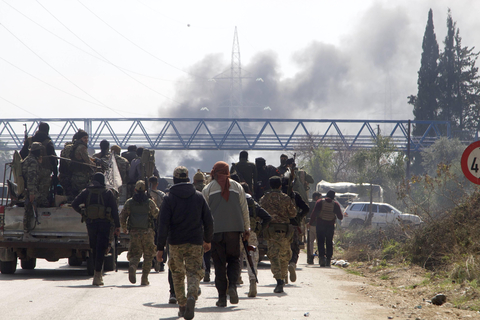
On March 6, the situation escalated, as Assad loyalists started an insurrection in the Alawite-majority coastal region. In reaction, the transitional authorities mobilized thousands of fighters from the newly formed security forces that includes HTS and SNA. The insurrection was crushed swiftly, and soon, massacres ensued all over the Syrian coastal region. Testimonies collected by the UN Human Rights office revealed, that “perpetrators raided houses, asking residents whether they were Alawite or Sunni before proceeding to either kill or spare them accordingly.” Entire families were eradicated in these killings, including women and children. In many cases, the militants themselves recorded their executions of unarmed people. Besides governmental forces, civilians from neighboring Sunni villages also participated in the pogroms. Almost 40,000 people have fled Syria to Lebanon since the start of the massacres, leaving villages like Arzah northwest of Hama completely emptied. Other places, like al-Mukhtariyah northeast of Latakia, had survivors reporting that almost two thirds of the village’s male population had been killed in the massacre.
When interim president ash-Shara’a announced the end of the military operation on March 10, he vowed to hold the perpetrators accountable. However, he hasn’t admitted his own responsibility. Neither have there been arrests of even those who openly broadcasted themselves slaughtering civilians. While some experts have argued that HTS has deradicalized and transformed itself into an organization with broader popular base, the clear sectarian motive of the pogroms and the lack of any accountability make this narrative questionable. In fact, a recent Reuters report that found 1,479 Alawites were killed in the massacres, stated that HTS units were present at 10 massacre sites, where almost 900 people were killed. Furthermore, armed Sunni civilians and militias under the umbrella of the Ministry of Defense – among them factions of the Turkish-backed SNA, as well as Jihadists from East-Turkestan, Uzbekistan and Chechnya – also were present at massacre sites where hundreds of Alawites were killed. The report also identified a chain of command from the perpetrators to a top Defense Ministry official via a leaked Telegram chat.
Normalization of international ties and continuing anti-Alawite violence
Nonetheless, the powers of the Global North are rushing towards normalization of ties with Syria. On March 17, a mere two weeks after the massacres, foreign minister As’ad ash-Shaybani met with European leaders in Brussels, as if nothing had happened. Not only that, Syria’s government was also promised €5.8 billion by international donors, including European countries. A likely motive in the European move to normalize relations is the return of Syrian refugees, which is hardly surprising considering the increasingly restrictive migration policies in the right-shifting political landscape in Europe. Likewise, US president Trump met with interim president ash-Shara’a on May 14, announcing the cessation of all sanctions.
Meanwhile, the violations against Alawite civilians continue. For example, Alawite civilians in Homs have been a regular target of unknown gunmen since early 2025. On March 21, the Syrian Observatory for Human Rights reported that 72 Alawites were killed in the last 24 hours, most of them in the coastal provinces. There are many more examples of massacres since then, which are mostly taking place on a smaller scale. One particularly worrying phenomenon is the proliferation of kidnappings of young women, which is reminiscent of the IS targeting of Yezidi women in 2014, albeit on a much smaller scale.
A footnote amidst democratization?
As the limited international attention has already moved on and the supposedly transitional Syrian government enjoys widespread support from the international community, it appears the Alawite massacres have become a mere footnote amidst democratization.
The lack of accountability for a major pogrom against a minority and the continued violence since suggest that maybe, Syria is not heading towards democracy and an inclusive system anymore, but towards an Islamist autocracy. By choosing to look away and prioritizing the return of refugees, the EU and the US have significantly contributed to this situation. It is not too late to exert meaningful pressure on the new government to hold it accountable and create a political environment that ensures the continued existence of the Alawite community in Syria.
- 1
Saydnaya was the location of a notorious torture prison of the Assad regime, were thousands of prisoners were held, some of them for decades, or killed in there.