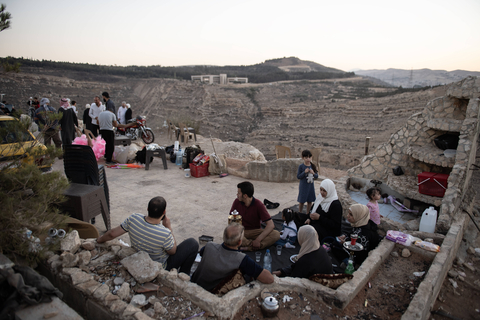
Syrians able to spend time on the outskirts of Damascus after 14 years DAMASCUS, SYRIA - SEPTEMBER 05: Syrians spend time in Mount Qasioun, which was closed for 14 years by the Bashar al-Assad regime and recently opened to visitors in Damascus, Syria on September 05, 2025. Syrians visiting the mountain and its surroundings with their families are spending time walking or picnicking while enjoying the view of Damascus.
IMAGO / Anadolu Agency
On a grey December morning in 2024, I stood before the Egyptian ministry of foreign affairs unique new building in my dark suit and carefully knotted tie, my head filled with questions, hopes, and fear. I was about to enter the oral examination — the final stage of the diplomatic and consular attaché competition, and the last step toward my long-sought goal. As one of the first graduates of the young Faculty of Politics and Economics at Suez University, I carried both pride and anxiety, knowing no one from my faculty had reached this stage before me.
The exam was scheduled for December 4, 2024, as if fate had a particular taste for timing; a personal moment saturated with stakes, coinciding with a regional moment brimming with exceptional turmoil. In northern Syria, the scene was hotter than the news bulletins suggested: Hay'at Tahrir al-Sham was advancing, and the authoritarian Assad regime was corroding from within, not with a loud noise but with the sound of corrosion itself. Assad's fall was a possibility, then a prediction, then, on December 8, a reality. We didn't wait long; just four days after my exam, Assad fell... forever.
I return to the examination hall. I was trying to compose myself before a committee of distinguished diplomats, receiving questions ranging across Arabic, English, and French. Suddenly, a well-known decent diplomat posed a final, direct question:
Why did Russia abandon Bashar al-Assad? And where did its military support go?
I answered calmly, relying on my knowledge and prior understanding of international relations, that it was related to Russia's preoccupation with the war in Ukraine and the shifts in its strategic priorities.
However, away from the examination hall, things did not proceed as I had hoped. I did not pass. I failed, just as the Syrian regime. Despite the bitterness, I carried many lessons from this experience – the exam and the fall together –. My failure in the competition was sad, yes, but it was nothing compared to the moment of true joy I felt on the day Assad fell and the joy of my Syrian friends.
And if my personal fall seemed like a limited individual experience, Assad's fall seemed like a large mirror reflecting a fall of another kind; the fall of a tyrant whose name was linked to a country of weight. Many around the world view Bashar al-Assad as a despotic dictator – a description that is not far off the mark – but the spectacle of his fall was not as dramatic as we imagined in movies. Rather, it was more like the slow slide of a heavy bust from its marble pedestal. A slide that elicits schadenfreude, but at the same time, awakens a degree of pity.
Assad, that Assad, did not flee to a cave in the mountains or a remote desert, but to luxury apartments in the heart of Moscow. According to a report published by the British newspaper The Times, his family owns about 20 apartments in the “Moscow City” area, purchased between 2013 and 2019, at a total cost exceeding £30 million. The Russian regime justified its sanctuary on its territory by “humanitarian reasons.” But let's ask frankly: do humanitarian reasons in the dictionary of politics carry the same meaning as they do in the hearts of the simple?
Here, I can only recall a scene from Samuel Beckett's famous play “Waiting for Godot.” I imagine Vladimir and Estragon, having replaced their barren tree with one of the Moscow City apartments, sitting in silence, not waiting for Godot, but for a decision about Assad.
Will he be handed over? Will he stay?
They talk, converse, and argue, but the outcome is the same: nothing happens. Like Beckett, we are spinning in a cycle of waiting, turning the meaning inside out, and arriving nowhere.
Will Assad, in his Russian exile with President Putin, become the embodiment of a new “Godot”? A person who does not come, is not held accountable, and is not forgotten? Will he become a new symbol of justice yet to be born? Will we also become like “Vladimir and Estragon,” waiting… just waiting?
In reality, Assad's fall was not merely the end of a tyrant, but a comprehensive fall of a regime that turned an ancient homeland into a marketplace for Captagon, and into a state that imprisoned its people between exile, graves, and prisons. It was a political and moral fall of a state that failed in everything but tyranny.
Nevertheless, the fall was not necessarily the end of the road, but opened a new stage for new actors. And here, Ahmad al-Sharaa' appears on the Syrian scene, not as a savior hero as some promoted, but as a politician trying to rebuild a nation exhausted by war. However, what seemed like a glimmer of hope at first quickly turned into new disappointment; mere months after taking leadership, it became clear that the man on whom the hopes for justice for a people who suffered decades of tyranny and years of war were pinned, was nothing but an extension of the same dilemma. His deep-rooted intellectual background in extremist Islamic currents, based on a logic of exclusion and violence, emerged to reproduce the authoritarian structure that Syrians revolted against.
The so-called “Constitutional Declaration” came to mark a pivotal moment in this path. It embodied, in essence, what Giorgio Agamben described as the “legitimization of the exception,” meaning the transformation of the exception into a constitutional rule that allows authority to escape the legal constraints that are supposed to limit it. Instead of being a step towards a new political contract, the declaration became a tool for re-establishing the very authority it claimed to transcend.
This trend was soon confirmed in practice, starting with the events in the Coastal region in March 2025, which claimed more than a thousand lives from the Alawite sect, to the disturbances in Sweida in July 2025, which revealed the fragility and fracturing of the social contract.
And so, once again, the essential characteristic of Syrian politics emerged: the reproduction of authoritarianism with changing tools and slogans, while the authoritarian logic itself remains, reproducing the tragedy instead of paving the way to overcome it. The transitional phase was nothing but a reformulation of the same oppression, leaving Syria captive to a present that weighs heavily on it and a past from which it has not detached.
I don't deny that this prolonged tyranny and this deafening silence are not new to the world of politics, nor strange to the path of tyrants throughout long human history. Indeed, contemplating the fates of despots, from Julius Caesar to contemporary men who thought time couldn't touch them, reveals that falling isn't always an end, just as rising is never a victory.