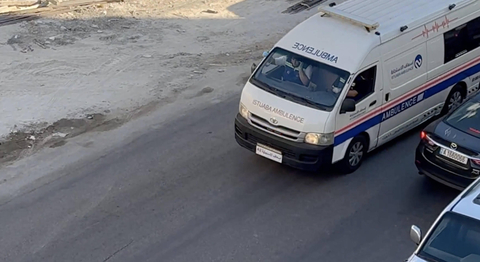
At least 8 killed, thousands injured after mass pager explosion in Lebanon SIDON, LEBANON - SEPTEMBER 17: An ambulance arrives at the site after wireless communication devices known as pagers exploded, and take injured people to the hospital in Sidon, Lebanon on September 17, 2024.
IMAGO / Anadolu Agency
In October 2024, a few weeks later, I was on my sister’s balcony in Germany when I saw her neighbor, a frontline medic, walking into his house. As he searched for his keys, I noticed a pager clipped to his hip. For a split second, my breath caught. Seeing that device sent a wave of anxiety through me, reminding me of the horrors of the attacks—the blood, the shattered bodies. What if this one was a threat, too? What if people who witnessed the attack saw it randomly?
This is ‘terror’.
What could this medic have thought when he heard about the attack? Did he know that physiotherapists, nurses, and doctors were among the victims? Did he hear about the two health workers who were killed for holding the same device he has on his hip?
The Day Pagers Became Bombs
This deep-seated fear was born on a single afternoon. On September 17, 2024, thousands of devices buzzed across Lebanon. Within the next minute, blood and human flesh were shattered in grocery stores, clinics, and hospitals. Panic spread. This was the opening act of a new era of warfare, ignited when Israel remotely detonated thousands of pagers used by Hezbollah members and, devastatingly, civilians. Twenty-four hours later, hundreds of walkie-talkies exploded. The two-day assault killed around 40 people and wounded more than 3,400 others, including children, doctors, and healthcare workers.
The goal was not only to kill, but also to mutilate and terrorize. Six grams of explosives were activated in every pager after the devices started to buzz. This notified users to press two buttons to read an encrypted message. However, the pagers exploded even without pressing any buttons, which is why many victims had holes in their abdomens and stomachs. Nearby people noticed the explosions and ran in fear, imagining various scenarios, but likely never conceiving of anything as "evil" as what had been planned.
The human cost is permanently etched in the memories of the survivors. Two 12-year-old children, Hussein and Ali, each lost one eye and had the other damaged, and lost multiple fingers in both hands. Hussein, whose grandmother picked his teeth off the couch, along with the tip of his nose, still needs around two years of surgeries. Ali was playing in front of the TV when he heard the buzz. He went to grab it when it exploded in his face. The psychological toll spread instantly. On that same day, my mother, like hundreds of thousands of other Lebanese, called me wondering whether it was safe to use her mobile phone, Wi-Fi router, or air conditioner.
Play of Terror
For its perpetrators, this campaign of terror was a carefully orchestrated "play." An agent from the Israeli Institute for Intelligence and Special Operations (Mossad) stated:
We write the screenplay, we are the directors, we are the producers, we are the main actors, and the world is our stage
The last part of his statement passed unnoticed, while it held a real threat to the whole world, literally.
The operation took years to develop. Israel sabotaged a whole supply chain, created a new product and battery, used the name of a well-known Taiwanese company (Gold Apollo), bombarded platforms with fake ads, and opened shadow offices in Hungary—all to kill and injure thousands at once. This “play” had been in the works for years before October 7, 2023.
Referring to such an attack as a play while thousands were left severely injured by the press of a single button should have raised a louder global alarm. While critical, the international response, while critical, has yielded no accountability. Then-EU Commission vice president, Josep Borrell, accused those behind the attacks of spreading ‘terror in Lebanon’, mentioning the ‘heavy collateral damage among civilians’. Amnesty International called for an international investigation, noting the attacks would breach international humanitarian law and could be war crimes. UN human rights experts denounced the deliberate, simultaneous detonations as a ‘terrifying’ breach of international law. According to Amended Protocol II to the UN Convention on Certain Conventional Weapons, ‘it is prohibited to use booby-traps (...) in the form of apparently harmless portable objects which are specifically designed and constructed to contain explosive material.’ No actual investigation has released a report.
A Precedent That Threatens Us All
Ordinary communication tools have been transformed into tiny bombs, and the world is at risk of becoming desensitized to them. This normalization diminishes the reality of the killings and makes future attacks seem "justified." The implications are global. Glenn Gerstell, the former general counsel of the National Security Agency, warned: ‘This might well be the first and frightening glimpse of a world in which ultimately no electronic device, from our cellphones to our thermostats, can ever be fully trusted.’
Although cybersecurity did not directly enable this attack, it illustrates the existential threats posed by digital-era warfare to everyday life. Tech entrepreneur Paul Biggar recently warned that hiring veterans from Israel's Unit 8200 for senior U.S. tech positions could create vulnerabilities, granting access to sensitive data. According to a recent investigation, by mid-2025, over 900 alumni of this controversial unit were working in the American tech sector.
However, the intent behind the attack goes beyond tactical advantage. Human rights lawyer Craig Mokhiber stated that it meets the general understanding of terrorism, being a ‘campaign of terror against certain parts of the Lebanese population for a political purposes.’ When asked about Israel’s moral reputation, a Mossad agent involved revealed the prioritization: ‘First, you have to defend your people so that they are not killed in the thousands, and then the reputation.’ This mindset culminates in a chilling message: the survivors are _‘living proof, walking in Lebanon, of ‘don't mess with us’. They are walking proof of our superiority all around the Middle East.’
This ‘superiority’, fueled by Western support, may yet backfire. The threshold of what is acceptable in conflict has been crossed, and the consequences will extend far beyond the region. For the Israeli Mossad, a pager is ‘a weapon just like a bullet or missile or mortar.’ If that becomes normal, then what’s next?
The answer to that arrogance did not come from generals or governments, but from a child. Twelve-year-old survivor Ali put it simply:
I want to study, work, and confront the Israeli enemy
That, too, is a consequence of the attack.