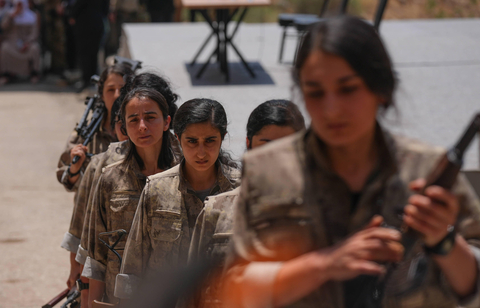
First group of PKK destroy weapons in northern Iraq SULAYMANIYAH, IRAQ - JULY 11: The first group of PKK terrorists, (listed as a terrorist organization by Turkiye, the U.S. and the EU), lays down and destroys their weapons in Sulaymaniyah, northern Iraq on July 11, 2025. In May, the terror group PKK, (listed as a terrorist organization by Turkiye, the U.S. and the EU), decided to dissolve and lay down its arms. The announcement followed a February statement by jailed PKK ringleader Abdullah Ocalan, who called for the dissolution of the PKK and its affiliated groups, urging an end to the armed campaign that has lasted more than four decades. In its 40-year terror campaign against Turkiye, the PKK – listed as a terrorist organization by Turkey.
IMAGO / Anadolu Agency
While the current turmoil unfolds in West Asia, Turkey is also experiencing its share of it. Yet, what sets Turkey apart is that the state has taken a strategic step to hurdle over obstacles to peace. Indeed, the developments point to the possibility of an end to the war between the Turkish state and the PKK (Kurdistan Workers’ Party), a conflict that has caused massive violence and destruction. Despite criticisms, the process holds significant promise for the Kurdish people, and therefore, even the slightest possibility of peace is worth acknowledging.
Once again, it is only those affected by this massive destruction and human rights violations who stand with peace. In Turkey, in particular, the nationalist opposition —fueled by a right-wing populist climate shaped by the government over many years—has been orchestrating numerous anti-peace campaigns. However, we know that an inclusive and lasting peace is only possible by gaining the support of every segment of society, or by reaching out to and engaging the most marginalized. A dignified life for all is only possible through peace.
In this context, this article discusses the peace process unfolding in Turkey and why it deserves support. Indeed, this article is a tribute to peace.
What Has Happened So Far?
In October 2024, for the first time in the history of the Republic, the chairman of one of Turkey's most nationalist parties, the MHP (Nationalist Movement Party), called on imprisoned PKK leader Abdullah Öcalan to speak in parliament and dissolve the PKK. To the public, this was a highly unusual move, especially considering the massive destruction and oppression targeting the Kurdish movement following the collapse of the 2015 peace process. However, what we have been witnessing until today suggests that the negotiations and plans for a new process were well-planned in advance, and both sides—namely, the Turkish state and the PKK—appear serious about moving forward.
Following this initial call, Öcalan’s isolation ended; several people—including family members, lawyers, and a dialogue committee—visited him in prison. On 27 February 2025, Öcalan issued a historic call for all groups to disarm and for the PKK to dissolve. In response, the PKK convened a congress from 5-7 May and declared it would abandon armed struggle. Later, on 11 July 2025, another historical moment took place in Suleymaniyah, Iraqi Kurdistan: 30 active PKK members laid down their arms in a ceremony.
Certainly, these developments cannot be understood without considering the broader political landscape in Turkey and . While all these were happening, many high-ranking officials and political figures described the Israeli state as a threat to Turkey. In December 2024, the Assad regime fell, and all neighboring countries, including Turkey, began maneuvering for political advantage in Syria. Meanwhile, the SDF (Syrian Democratic Forces1), whose political perspective aligns closely with PKK, significantly strengthened its influence in Syria, particularly after HTS's (Hayat Tahrir Al-Sham)2 massacres of Alawite and Druze minorities.
By October 2024, political pressure on Turkey’s main opposition party, CHP (Republican People’s Party), intensified. The anti-democratic trustee (kayyum) policy previously applied to Kurdish municipalities was now extended to CHP-run municipalities. Several mayors, including Ekrem İmamoğlu, the current mayor of Istanbul and Erdoğan's likely rival in the presidential race, were arrested. Furthermore, following the designation of 2025 as the "Year of the Family," a sweeping anti-gender campaign targeted feminist and LGBTI organizations with severe political pressure.
In parallel, prisoners imprisoned for PKK-related activities, whose sentences had previously been extended, or those who were ill, have been released almost daily. While these developments could have typically been considered as fundamental rights, they stand out as significant political gestures and opportunities under the extreme conditions created by the racism imposed on Kurds at both state and societal levels.
The appointment of trustees to municipalities, which has been in place since 2015, is now being halted. In many cities, local administrations are no longer prevented from offering services in their native language, such as Kurdish cultural events and signs. For the first time in decades, the Kurdish legal movement, DEM Party, can engage in political activity without obstruction.
More importantly, the Kurdish people, described as the world’s largest stateless people, are, for the first time, being shown the possibility of recognition as legitimate citizens. This shift is met with caution, shaped by a deep awareness that hostility towards Kurds has long been a fundamental characteristic of the Turkish state, whether under CHP, AKP (Justice and Development Party), or MHP. At this juncture, peace is being pursued through the state, with the parliament as the main negotiation arena.
A New Positionality for Peace
In Turkey, as in all regions affected by long-term conflict and hate campaigns, resistance to peace endures. This resistance also manifests as caution among those without nationalist tendencies, such as leftists, Kurds, women, and LGBTQ+ individuals. So, why support this process? What stance should be taken?
What is peace in Turkey?
First of all, it is worth emphasizing two simple points. Peace offers, at worst, nonviolence (negative peace) and, at best, a dignified and just life for all (positive peace). Therefore, supporting peace means, in the simplest terms, advocating for an end to deaths in the Kurdish issue. Peace is, by nature, a reciprocal action that must be built between the PKK and the current government, which represents the state. Those opposing the process have a solemn obligation to explain their position on these two fundamental points. One question for those who argue against negotiations with the PKK is: How long should the war continue? Where should it stop? Until the PKK is eliminated? Or, until every Kurdish person who joined the PKK is killed?
Peace and Democracy
Another key criticism concerns agreeing with a government that engages in anti-democratic practices. One recurring question during this process was whether peace can exist without democracy. But then, upon reflection, is democracy possible without peace?
To start with, one of the root causes of Turkey’s democracy problem is the Kurdish issue. For decades, the state committed severe human rights violations, such as forced displacement, racially motivated killings, and denial of cultural rights, under the guise of “fighting terrorism.” On the other hand, Turkey saw its “most comprehensive” democracy between 2013 and 2015, when steps were taken toward peace with the Kurds. The largest and freest Pride marches, as well as more inclusive participation from all parties in democratic politics, were only possible during this process. In other words, democracy for everyone in Turkey was only conceivable when the Kurdish issue was close to resolution.
Continuing with this reflection, another conclusion emerges: the success of the current peace process may, in all likelihood, also trigger democratic progress. Can democracy truly remain unaffected by resolving the Kurdish issue, which lies at its very root?
For instance, as in many parts of the world, one of the biggest obstacles to democracy is the rise of right-wing populism. It seems highly probable that peace will break the cycle of polarization and violence and narrow the scope of right-wing populism in Turkey. Moreover, the Kurdish movement has long stated that its fundamental goal is to democratize the countries in which it exists, and this has become increasingly visible in Turkey. The DEM Party, a pro-Kurdish movement, particularly with the transformation it underwent prior to the former peace process, brings together various leftist struggles under one umbrella, encompassing anti-capitalist Muslims, environmental, feminist, and multiculturalist movements.
Defending Peace in Turkey: A Complex Approach
The purpose of this article is to call for greater support for the peace process in Turkey, both among citizens of Turkey and internationally. Although the Kurdish people, who have been most affected by the war’s destruction, support this process, many studies show that it has not been sufficiently disseminated or embraced at the societal level. Yet even the faintest hope for ending a war that has claimed tens of thousands of lives and caused immense material damage deserves praise. Rejecting the prospect of peace risks plunging not only Turkey but also the peoples of the entire West Asia and even Europe into another cycle of violence with no end in sight. This spiral will benefit no one but profit-driven elites and right-wing and fascist agendas.
Defending peace should never mean compromising on the ideal of an "honorable life for all”. In other words, supporting peace in Turkey does not equal endorsing the current government’s anti-democratic practices. What is needed is not a rejection of this historic opportunity, but a clear-eyed approach that can respond to the emerging political realities: one that supports the intention to build peace and stands firmly against anti-democratic backsliding. The task before everyone is to foster a new understanding of how this peace will give birth to democracy.
In this context, national and international support for the peace process must be expanded, and the visibility of positive possibilities created by the process should be enhanced. A key goal is to socialize the process further. The more the process is embraced at the societal level, the less likely it is that violence will resurface or take on new forms directed at non-Kurds. Likewise, the dichotomy that peace is solely an issue between the Turkish state and the Kurds must be dismantled. Peace belongs to everyone: women, Turkish nationalists, LGBT+ individuals, people with disabilities, migrants, all religious and ethnic minorities, and even those without political affiliation. Therefore, the peace process must evolve into a space where different voices are heard, collectively owned, and questioned.
States and societies in West Asia and Europe must also participate. As capitalism moves toward crisis and war, genocide, and the glorification of wealth surge across the world, defending peace is one of the most potent ways to resist.
As this article comes to a close, it is important to remember once more who is demanding peace. While the children of Taybet İnan — a 57-year-old mother of 11 killed amid war in Cizre in the final months of 2015, her body left unburied for seven days — continue to demand peace despite everything. The rest of the world can surely commit to building it under better conditions.
- 1
The SDF, known as (قَسَد) is a political and military umbrella organization dominated by Kurdish and left-leaning military groups in Syria. Its components include Kurdish, Arab, Turkmen, Armenian, Syriac, Yazidi, Chechen groups, and feminist women's groups such as the YPJ.
- 2
The HTS the current defacto government in Syria. HTS is a political and military formation that essentially comprises a military group known for its numerous opposition against Assad regime. In particular, the history of its leadership and the groups it encompasses, the widespread crimes against humanity committed in Alawite and Druze regions after coming to power, and its unipolar, Arab nationalist, and Islamist perspective, which it defended in negotiations with the Kurds, have drawn attention.