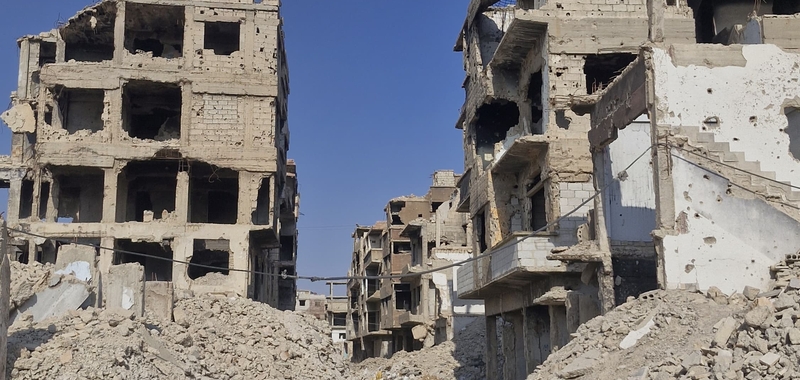
Over 14 years of conflict, the Assad regime deliberately and systematically destroyed the Yarmouk Camp (مخيم اليرموك). Its residents were displaced, its properties were demolished, and its infrastructure was obliterated, resulting in profound demographic changes. Alongside this destruction, the regime had an organizational plan to rebuild the destroyed neighborhoods, including Yarmouk Camp, as luxury residential areas, threatening Palestinians with permanent dispossession and erasure of their cultural identity. Thankfully, the plan failed with the fall of the Assad regime. Following the fall of the regime, the fate of the camp remains uncertain as there is still no reconstruction plan for Syria as a whole or Yarmouk in particular. Without clarity, the future of Palestinians in Syria is undetermined.
Property Rights of Palestinians in Syria: Legal Ambiguity and Systematic Dispossession
Palestinians' rights regarding housing, land, and property in Syria are highly complex. This is due to variations based on the year the refugee arrived in Syria, as well as the fact that the legislation is open to interpretation. On December 26, 2012, the Yarmouk Court building was deliberately destroyed by the regime. The building contained most of the camp's civil legal documents. Many documents were lost, including property records and marriage contracts for which there were no electronic copies. In a letter, the German and Turkish delegates to the United Nations referred to this practice as part of a policy aimed at altering Syria’s demographic structure.
It was destroyed alongside the municipality with the intention of destroying the camp's infrastructure. This was the first systematic step in a series of actions aimed at creating demographic change in the camp to enable the establishment of a new organizational plan. This plan materialized after years of siege, starvation, and deliberate destruction. ISIS's presence in the camp was also used as a pretext to destroy the area. Between April and May of 2018, a scorched-earth campaign resulted in the destruction of Yarmouk Camp and the evacuation of its residents.
The success of the regime's project is reflected in The Guardian's description of Yarmouk Camp in its March 2015 issue, which describes it as "the worst place on Earth." Meanwhile, Christopher Gunness stated that the camp is “a new term added to the lexicon of man’s inhumanity to man.”
These dominant interpretations have stripped Palestinians of any capacity for action and robbed them of their identity throughout the humanitarian crisis.
In the same context, starting in 2011, the regime used the legal framework and the camp redevelopment plan to abuse the housing, land, and property rights of Palestinians under the guise of a post-war reconstruction plan. In reality, the regime altered the demographic composition of areas that had supported opposition groups by preventing the return of former residents and enacting laws that enabled it to seize land and property.
The loss of documents while seeking asylum in Europe made it difficult to claim rights. Victims of arbitrary detention and enforced disappearance lost their housing, land, and property rights. More than half of Palestinian Syrians lost their homes and possessions, and many left the country, especially after the final assault on Yarmouk Camp. The regime prohibited Palestinians from returning to Yarmouk and other camps, and it prevented Yarmouk residents from removing bodies buried under the rubble due to its military campaign.
The Yarmouk Camp
Yarmouk Camp is considered the most significant Palestinian gathering in Syria. According to statistics published in 2012 by UNRWA, it is home to 300,000 people, including 160,000 Palestinians. Established south of the Syrian capital, Damascus, between 1956 and 1959, the camp spans 2.1 square kilometers and is located four kilometers from the Damascus Governorate building in the city center. Yarmouk was one of the most developed camps in terms of its buildings, markets, commercial shops, and infrastructure.
The camp’s significance extended far beyond its size or infrastructure. It held a unique legal and administrative status managed by a local committee under the Ministry of Local Administration. This allowed the camp a degree of autonomy not granted to many other Palestinian camps in Syria. The camp flourished outside the scope of urban development plans that encompassed the rest of the Damascus Governorate. This gave its residents the space to shape the camp's development on their own terms.
Despite facing decades of legal discrimination, systemic marginalization, and Ba'athist1 authoritarianism, Yarmouk's residents built a resilient, politically active, and socially cohesive community. Known for its high levels of education, professional engagement, and civic participation, the camp became a vibrant sociocultural hub. Palestinian civil society in Yarmouk was characterized by mutual aid networks, grassroots initiatives, and a strong sense of communal solidarity, particularly during periods of political and economic hardship.
The people of the camp built a unique, solidarity-based community with few resources. Despite the discriminatory laws and marginalization they experienced, the people of Yarmouk lived through as much as almost all other Syrian residents under Ba'athist oppression and managed to maintain an empowered community.
Before its complete destruction by Syrian regime forces and Russian airstrikes, Yarmouk Camp went through several stages to reach its final form. Commercial markets began to appear in the camp in 1985, and they continued to expand until the camp included the largest automotive and ceramics markets in Damascus, as well as the gold market and the well-known Souq Loubiyeh clothing market.
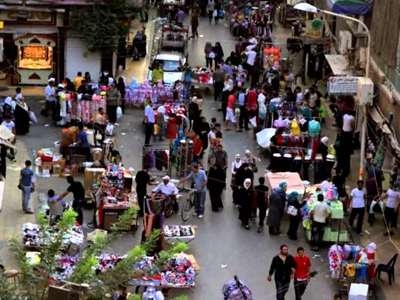
Source: retrieved from Palestine.net, taken before 2011.
As a result, the price per square meter in commercial areas, such as the clothing shops in Souq Loubiyeh, rose to $20,000 on the eve of the Syrian revolution. The camp also had four hospitals, a fifth hospital under construction that was funded by Japan, and several clinics run by UNRWA. The camp also had four hospitals, a fifth hospital under construction that was funded by Japan, and several clinics run by UNRWA. There were also more than 3,000 doctors specializing in various fields, as well as several schools and private institutes. According to the report "Yarmouk Camp as a Case Study" by Ansar Jassem, Abdullah Al-Khatib, and Abdulrahman Shahin, published by Impunity Watch and PAX in 2022, it also included a cinema, several cultural centers, youth care facilities, women’s centers managed by UNRWA, a swimming pool, a sports complex, and a football stadium suitable for international matches.
Strategy for the Destruction of the Camp
Following the outbreak of the Syrian revolution, Yarmouk Camp became a refuge for Internally Displaced Syrians seeking safety. The camp welcomed people from nearby areas as well as from distant cities across the country. Rooted in a strong sense of solidarity and community, the camp's residents took the initiative to organize themselves, develop response plans, and provide support to those in need. As a result, humanitarian services, including shelter, medical care, and food assistance, were offered to the displaced. However, the Assad regime viewed this spirit of humanity as a threat to state authority. The regime interpreted the camp’s efforts as equivalent to aiding opposition fighters in areas beyond its control.
In response, the regime pursued a systematic strategy aimed at dismantling the camp and displacing its residents. This strategy unfolded in several stages, employing various pretexts that posed direct threats to the housing, land, and property rights of the camp’s population. The steps adopted by the regime as part of this broader strategy include the following:
- Bombardment
In the last quarter of 2012, specifically on December 16, the Syrian regime’s air force launched air raids targeting two displacement shelters in the camp: Abd al-Qader al-Husseini Mosque and Falouja School. The bombardment aimed to cause the highest possible number of casualties and to force as many residents of the camp as possible to leave. Within days, 80% of the camp’s residents departed toward surrounding neighborhoods, where they stayed in shelters established in mosques and schools, or moved toward other Palestinian camps.
Yarmouk Camp was the first area targeted by the regime’s airstrikes. The area was bombed even before the armed opposition took complete control. Afterwards, the camp was bombed almost daily. One such incident was the bombing of the Yarmouk Court building mentioned earlier. The systematic destruction of property records also occurred in Homs, Zabadani, Daraya, and Qusayr.
- Starvation Siege
Following the December 2012 airstrikes, the regime established a checkpoint at the camp’s northern entrance to control movement in and out. Dozens of camp residents were arrested at the checkpoint.
On July 18, 2013, the regime permanently closed the checkpoint, imposing a full siege on the remaining 18,000 residents. Entry of food, medicine, and fuel was prohibited entirely, and services including water, electricity, and mobile phone networks were cut off. According to Amnesty International's report, between July 2013 and 25 February 2014, 194 people, including children and infants, died due to a lack of food and medicine.
In February 2014, the checkpoint partially reopened, and 6,000 people left the camp while 12,000 remained. This was the number present when ISIS entered the camp in 2015. ISIS remained there until the regime regained control in 2018.
- ISIS: A Pretext for Destruction
After the group seized control of the camp in April 2015, the regime dropped dozens of barrel bombs, causing widespread destruction under the pretext of eliminating ISIS. However, these campaigns only impacted civilians and the camp’s infrastructure. By the time the regime regained control of the camp in mid-2018, half of the remaining 12,000 residents had fled.
In addition to the bombardment, ISIS exploited the camp’s infrastructure for profit. ISIS conducted commercial exchanges with the Syrian regime through intermediaries, including negotiations over a deal to sell tons of copper. Water and electricity stations were looted and transferred to regime-affiliated black markets in coordination with intelligence forces.
- Scorched-Earth Policy: 33 Days of Bombardment
On April 19, 2018, the Syrian regime launched a massive military campaign on the camp with the support of the Russian army. The stated objective was to eradicate ISIS, but the outcome was different. Russia paid no attention to Palestinian refugees, their rights, or the significance of the camp to them and their cause. Alexander Zorin, the Russian military representative in Syria, stated: "The goal is to eliminate ISIS, even if it requires the complete destruction of the camp."
Over a period of 33 days, the Syrian regime and Russian forces bombed the camp continuously and intensely, using all kinds of weapons. This level of bombardment was completely disproportionate to the number of ISIS fighters remaining within the camp’s boundaries. Entire neighborhoods were bombed and leveled, destroying 80% of the camp.
A deal was made between the regime and ISIS, the terms of which are unknown. It involved the withdrawal of ISIS fighters toward the southeastern Syrian desert and the entry of the regime and its militias into the camp.
- Systematic Looting: “Ta'feesh”
After the regime seized control of Yarmouk Camp, the camp was subjected to systematic looting of the homes of displaced residents in particular and the area in general. The looting did not stop at homes and possessions. It also extended to infrastructure, including electrical wires, high-voltage cables, and underground water pipes. This led to the destruction of the remaining camp infrastructure. Thieves broke into abandoned houses on Street 15 to steal iron and metal items. Gangsters have also used violence and firearms to terrorize civilians protesting the burglaries. Civilians’ appeals for urgent action have gone unheeded.
- Closure After Flattening
The systematic looting ended in early 2019, after which the regime allowed only the families of its loyal fighters to return to parts of the camp. The complicated security conditions preventing the rest of the camp’s residents from returning indicate a clear intention to strip Yarmouk residents of their right to homeownership. These conditions also confirmed that all of the regime’s campaigns—from aerial bombardment to military assault—were designed to achieve one goal: the destruction of the camp and displacement of its residents. This would allow the area to be included in the new general urban planning scheme for redevelopment.
2020 Urban Plan
In 2020, the Syrian regime announced an urban development plan for Yarmouk Camp that would have brought the camp under the jurisdiction of the Damascus Governorate, effectively ending its relative autonomy. If implemented, the plan would have altered the camp’s demographic makeup and erased its Palestinian political identity.
In response to the urban plan, the General Authority for Arab Palestinian Refugees sent a formal objection. The plan divided the camp into three main areas based on the regime’s assessment of damage levels in each part. According to the plan, 60% of the camp would be converted into residential towers, commercial markets, and public gardens. Residents of the remaining 40% — the lightly damaged area — would be allowed to return on the condition that they prove property ownership, a process expected to take years. In every respect, the plan represented a serious threat to the essence of the Palestinian presence in Syria.
Between Hope and Uncertainty: What the Fall of Assad Could Mean for Yarmouk Camp
For all Syrians, the fall of the Assad regime carried hope and created potential for a state based on social justice and equality. For Palestinians, the fall also meant the urban plan collapsed along with the regime.
Any future government must repeal all laws that discriminate against Palestinians in Syria and treat them equally, regardless of their date of arrival in the country, if it intends to adhere to international refugee law, particularly the 1951 Refugee Convention. Radical reforms must also be enacted regarding the laws governing housing, land, and property rights for Palestinians, ensuring that they enjoy full rights from the state, given that they bear the same responsibilities toward the state as Syrian citizens, and are, indeed, an integral part of Syria’s social fabric.
Any future urban planning scheme must serve the higher interests of the relevant stakeholders, who, in the case of Yarmouk Camp, are the Palestinian refugees. Therefore, their interests must be represented on the committees responsible for such planning by genuine representatives delegated by the refugees themselves. Organizations concerned with Palestinian affairs must also play a supervisory role in matters of planning and implementation