
Since 2015, the Syrian Democratic Forces (SDF) have played a pivotal role in the complex Syrian conflict. This multi-ethnic coalition emerged as the principal U.S. partner in the arduous fight against the Islamic State (IS) and has evolved into the de facto military and security force governing a significant portion of north-eastern Syria. Exploring the SDF's origins in the context of Kurdish dissidence is necessary to understand its complex structure, the political project it supports, its intricate international relationships, and the ongoing human rights issues that call into question its legitimacy.
In spring 2011, people in Syria went out onto the streets of Daraa, Homs and Aleppo in protest against the government. They were demanding social and political change. At the same time, people in Hasaka and Qameshlo were less keen to join in. The memories of the 2004 riots, following a soccer game between the Kurdish fans of a local team and the supporters of El-Fetouweh team from Deir-el Zor, were still being felt. The riots lasted for days and 30 people were killed and 160 people were injured.
In the ensuing years, the Assad regime persisted in its oppressive measures targeting political activists in the principal Kurdish parties, including the Democratic Union Party (PYD), the Yekiti Party, the Future Movement, and the Azadi Party, amongst others. Furthermore, Arab Sunni political opposition has been less vocal with regard to the ethnic and cultural rights of the Kurdish minority. For instance, the well-known opposition figure and human rights advocate, Haytham al-Maleh, has explicitly expressed his opposition to the demands of the Kurds regarding linguistic and cultural rights, as well as their vision for decentralised rule in Syria after Assad. In a similar fashion, the Syrian National Council (SNC), which was established in 2011 in Antakya, rejected the aforementioned Kurdish demands.
It is evident that a multitude of factors have contributed to the decision of Kurdish political parties, which were comparatively more organised and present on the local political scene, to abstain from joining the Arab Sunni opposition. Instead, these parties established their own national council known as the Kurdish National Council (KNC). As rivalries within the different political groups intensified, the PYD, cognisant of its close ties with the Kurdish separatist movement in Turkey represented by the PKK, self-declared, in November 2013, an autonomous interim government in the regions of Rojava ( North East Syria) in charge of three ‘non-contiguous autonomous’ cantons ( Afrin, Jazira and Kobani). Later, in2013, the People Protection Units (YPG) and the Women Protection Units (YPJ), which were charged with preserving order in the Kurdish-majority populated areas were officially established. This was the direct consequence of a negotiated compromise with the Assad regime, which led to their withdrawal from the Kurdish areas in the face of escalating sectarian violence that had engulfed Syria, particularly in the wake of civil unrest among the Arab Sunni population. In this particular context, Bashar al-Assad promulgated a presidential decree that accorded nationality to more than 300,000 Kurdish residents. These individuals had been systematically classified as stateless in their own country due to the discriminatory practices of the Baath Party in the 1962 census.
In this context, the Islamic State in Levant (ISIL) represented the ultimate danger to the north-east of Syria. They were able to capture EL-Raqqa in January 2014 and gain much power as they expanded into large territories while connecting disparate regions in Iraq and Syria under its dominion. Consequently, in 2015, the Syrian Democratic Forces (SDF) emerged as a multiethnic force, including fighters from Arab, Syriac/Assyria and other Christians backgrounds, predominantly led by the Kurdish forces, YPG/ YPJ, aligned with the US-led coalition.
The SDF received training, arms and equipment from the coalition, and were integrated into its direct operations against ISIL. Following the defeat of ISIS in 2019, the SDF became the official forces of the interim government in northeast Syria. They became responsible for protecting a significant part of Syria, accounting for around 50,000 square kilometres(almost five times the size of a country like Lebanon).
The Political Project and governance
The SDF is not just a military force; it is also the defender of a groundbreaking political experiment which implements a model of ‘democratic confederalism’. Inspired by the writings of Abdullah Öcalan, this philosophy emphasises decentralised, bottom-up democracy, ethnic pluralism, and radical gender equality. Their political model promotes co-governance between Arabs, Kurds, Syriacs and other groups. It stipulates that every leadership position must be held by a male and a female co-chair. This political project forms the ideological core of the political administration in the northeast of Syria and distinguishes it fundamentally from both the Assad regime and other Syrian opposition groups.
The SDF originally brought together 12 military groups from Arab, Kurdish and Syriac origins1. The group stated their objectives as looking to establish à Syrian state where all Syrians from different origins can enjoy freedom, justice and dignity without any kind of discrimination. They also identified their fight against ISIL as ‘the top of their military objectives’. It was reported that more than 11,000 of the SDF forces were killed in their fight against ISIS. Shortly after, they started receiving direct support in terms of arms and equipment from the US-led coalition as a spokesperson of their media office told Al-Jazeera in December 2015.
Available information show that the SDF is composed of a multilayer leadership structure (see figure below). Their military council represents the upper governing body which is composed of representatives from all the composition factions, it has the say of the decision related to war and peace and they elect the commander-in-chief.. The latter is in charge of the council meeting and the general command of SDF. He is assisted by an elected group of 9 to 13 members from the general council and they form the executive governance body. In parallel the administrative structure includes a number of bureaus with specific mandates.
However , the group has several specialized units like the counter-terrorism forces (HAT) and the rapid interventions forces (YAT) in addition to intelligence units as stated by Same al-Ahmad, a prominent researcher in northeast Syria, to the media outlet Enab Baladi. He also underlined that SDF is relying on local councils in areas like Deir Ezzor, Manbij and Raqqa to ensure security in these areas. Al-Ahmad pointed to the fact that some of the officials in posts at SDF are not necessarily Syrian nationals due to the group's organic ties with the PKK and its armed forces.
By 2017, SDF accounted for more than 60,000 fighters predominantly composed of the YPG/ YPJ groups from Kurdish ethnicity. The group is also relying on the mandatory military services as all adult men (aged between 18 and 40 years old) are required to join the group unless they have special exemptions. The US military budget for the fiscal year 2017-2018 allocated tens of millions to fund a so-called vetted Syrian opposition (VSO) which are identified as not affiliated to extremist ideology. In particular, it was reported that around 30 thousand fighters that are completely depending on the US logistical and financial support2 The organized crime and corruption reporting project (OCCRP) reported, in 2017, that the Pentagon has been planning to supply 2.2 USD billion in terms of soviet-style arms, equipment and ammunition to VSOs of which SDF is a main player. The US support continued over the years, 300$ million for border security in 2018, even after the fall of the Assad regime in 2024.
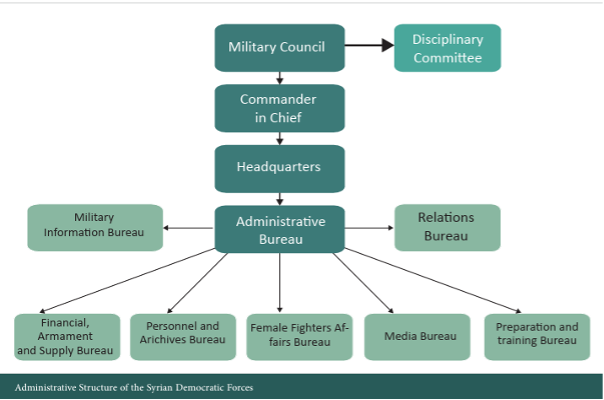
Source: King Faisal Center for Research and Islamic Studies. (2016). Syrian Democratic Forces (SDF). Riyadh: KFCRIS. Retrieved from https://www.kfcris.com/pdf/2b2225c00020fa12fcdb990701b690f9581a512c9a455.pdf
Human rights records
Several international organisations have accused SDF of breaking human rights laws, especially when it comes to recruiting children, as seen with YPG and YPJ. In fact, both organisations were listed by the UN special report on child soldiers as actively involved in forcing underage children to join their ranks. This goes back to 2014, when Human Rights Watch reported several cases of child recruitment by opposition and non-state groups. These included the Kurdish forces, as well as battalions from the Free Syrian Army (FSA), Jabhat al-Nusra (re-named HTS) and ISIS. The text is now simpler. In 2018, the UN secretary council reported that 313 children, both boys and girls, were fighting with the SDF groups. SDF usually recruits people from refugee camps without asking their families. Children used to disappear for months before their parents, who lack any kind of contact with their kids, were told that they were in training. Reports show that the SDF has a division for young people called the Revolutionary Youth Movement (RYM). This group is responsible for recruiting children, both forced and voluntary. The HRW reported that they had interviewed parents of at least seven children, as young as 12 years old, who had been recruited by RYM in the period between March 2023 and July 2024.
Other reported violations are related to their involvement in running and supervising 27 detention and interrogation facilities, as well as the Al-Hol and Roj detention camps. Overall, Amnesty International reported that around 56 thousand people are detained in these facilities, more than half of whom are children, while around 12 thousand are men and around 15 thousand are women. A 2020 UN report underlined that all the armed groups in Syria, including SDF, are involved in violation of human right, torture and forced disappearing. In specific, they pointed to the fact that SDF’s “long-term internment of allegedly ISIL-associates in the northeast, amounts to unlawful deprivation of liberty in inhumane conditions, that cannot continue in perpetuity”.
A web of complex alliances and enmities
The SDF's relationships with regional and international powers are volatile and define its existence. In the case of the United States, for example, the relationship is a strategic military partnership of convenience. However, this support is strictly military in nature, and the US does not officially endorse the AANES's3 political project or its autonomy from Damascus. This is, however, undergoing close scrutiny in the post-Assad era, as the emerging rulers in Damascus have gained a strategic foothold in US strategy in the region. Evidence of this emerged in winter 2025 when Abadi Mazloum, the SDF's general commander, was invited to Damascus by the US envoy to negotiate a power-sharing agreement with interim president Ahmad El Sharaa.
Conversely, Turkey poses an existential threat to the SDF, having designated the YPG as an inseparable extension of the Kurdistan Workers' Party (PKK), which it considers a terrorist organisation. Ankara views the SDF-controlled border region as a threat to national security. This has resulted in three major Turkish military incursions into Syria: Operations Euphrates Shield (2016), Olive Branch (2018) and Peace Spring (2019). These incursions have displaced the SDF from key areas such as Afrin. The constant threat of another Turkish invasion informs every SDF decision.
Their relationship with the Syrian regime and Russia was one of tense, pragmatic coexistence. The former regime opposed the SDF's autonomous project, but tolerated it as it was considered a lesser evil than Turkish or jihadist control. Russia acts as an occasional mediator. In areas such as Qamishli, regime and SDF checkpoints were located close to one another. This uneasy stalemate was maintained by the presence of US forces acting as a buffer. The SDF was caught between seeking autonomy and potentially having to strike a deal with Assad to survive if US support were withdrawn. However, all this changed in December 2024, and the SDF must consider what kind of relationship it would have with the central government in Damascus.
Today, they stand at a crossroads, defined by a series of profound contradictions. They are internationally recognised as successful counter-terrorism partners, yet a neighbouring NATO power has designated them as terrorists. They govern a multi-ethnic region with a progressive political model, yet they face serious and persistent allegations of human rights abuses and the marginalisation of non-Kurdish ethnic groups. Their relationship with the new regime remains volatile, as they have yet to agree on power sharing and on the specifics, with the agreement signed last March 2025. As with the future of Syria, their future is clouded by challenges and fear of violence escalation.
- 1
This included the YPG, YPJ, Al-Sanadid Forces, Syriac Military Council (Sotoro), Euphrates Volcano Joint Operations Room, Raqqa Revolutionaries Brigade, Northern Sun Battalion, Al-Salajiqa Brigade, Al-Jazeera Brigades Gathering, The Kurdish Front, Al-Tahrir Brigade, The Rebels Army (which includes: The Kurdish Front, Troops Brigade 99, Special Operations Brigade 455, Al-Salajiqa Brigade, Ahrar Al-Zawiya Brigade, Sultan Salim Brigade, and Atarib Martyrs Brigade)
- 2
These groups used to receive ‘salaries, weapons, and food’ directly from the US in addition to $60 million (USD) fund “fot ongoing operations”, $40 million (USD) for transportation and $7 million (USD) for “basic life needs”. Meanwhile, $300 million (USD) were allocated for training and supplies in 2017 and 400 million in 20
- 3
Autonomous Administration of North and East Syria (AANES) previously referred to as “Rojava”.