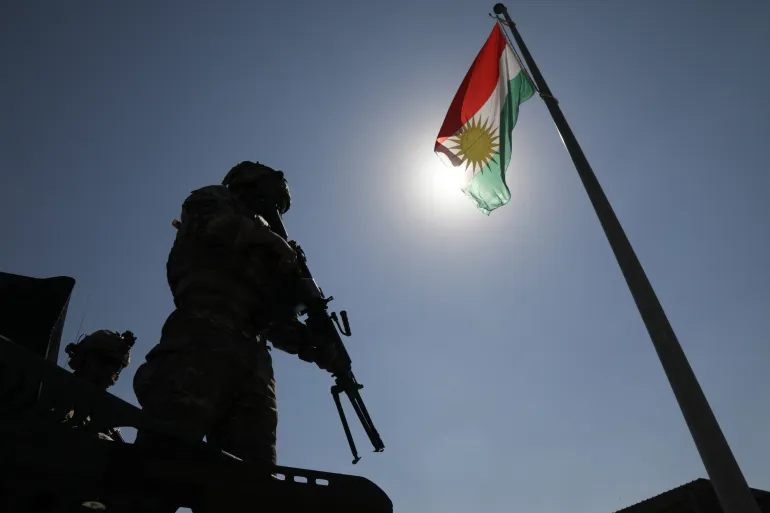
Since the October 2024 parliamentary elections, Iraqi Kurdistan (KRG - Kurdistan Regional Government) has faced a prolonged governance crisis, driven by disagreements and political ambitions between the KDP (Kurdistan Democratic Party) and the PUK (Patriotic Union of Kurdistan).
The two parties, which have dominated the Region's political institutions for decades, remain divided over the distribution of senior government positions and the future of their power-sharing arrangement. While the KDP seeks to consolidate its political influence, the PUK has attempted to preserve its position as an equal partner, including through its alliance with the New Generation Movement in July 2026.
Meanwhile, the Iran-Israel-U.S. war after February 2026 affected the KRG's political landscape completely. Regional threats have increased the need for cooperation among Kurdish political actors, yet deep mistrust between the PUK and the KDP continues to undermine a unified response. As a result, the Kurdistan Region faces several interconnected crises: an institutional deadlock, growing economic dependence on Baghdad, and mounting pressure from neighboring states. Whether these challenges encourage meaningful political cooperation or deepen existing divisions remains uncertain.
Between Kurdistan and Iraq
The Kurdistan Region, an autonomous region under the central Iraqi federal state, is the only part of the four-part Kurdistan: Turkey, Syria, Iran, and Iraq, with a strong legal status. It differs in factors such as its legal status and oil economy. However, Kurds in the KRG share a similar fate to the Kurds in the other regions. Particularly, the ongoing peace process in Turkey, the transition underway in Syria, and the recognition in Iran of the Kurds as a group capable of altering the course of the war have demonstrated how interconnected Kurdish politics are.
In this context, the real risk is that, instead of working with each other and with other Kurdish movements, the leading parties build fragile, unreliable alliances with neighboring states. Any relationship the PUK builds with Iran, for example, will not be on equal terms. A unified foreign policy, by contrast, could give one of the region’s most isolated peoples some room to breathe.
Relations with Baghdad have been volatile, and oil revenues have shaped this relationship. Notably, KRG's efforts to build its own oil pipelines in 2014 led to a major crisis with Baghdad. Since then, the balance has shifted: oil exports were handed over to Baghdad, and a new customs system stripped KRG of control over border revenues. Thus, Erbil’s financial autonomy has eroded. Nevertheless, the indirect legitimacy provided by the PKK (Kurdistan Workers’ Party) process and the disarmament of militias could steer the relationship toward relative stability.
Politics for Kurdistanis, Not for Families
Since its establishment, the KRG has operated under the dominance of the two families: the Barzani (KDP) and the Talabani (PUK). From public institutions to the media, and from the oil sector to anywhere state power can be exercised, these families exert direct or indirect influence. This alone undermines the rule of law and meritocracy. However, another striking issue is that decisions affecting the lives of Kurds are shaped by competition between and within these families. Such a system weakens accountability mechanisms, erodes trust in the courts and the legal system, and creates its own elite. The elites pursue politics for their own sake, and can appeal to only one-fifth of the population. This demonstrates that the political ambitions of these families have strayed from the needs of the Kurdish people.
This system has lasted so long because of the relative prosperity created by the oil economy and the atmosphere of fear generated by neighboring states; however, under these conditions, an oil-based approach is likely to fail to offer the public anything of value. Likewise, politics run by families for families is a disadvantage in terms of strengthening intra-Kurdish politics, particularly regarding unification within the KRG. Overcoming this obstacle is crucial if the Kurds are to retain their status as a decisive actor capable of shaping their own political future.
Peshmerga Unification: Real Change or Cosmetic?
The first major step taken in response to regional developments was to accelerate the process of unifying the Peshmerga forces. Ahead of the withdrawal of the anti-ISIS coalition and the U.S. from the KRG, and amid threats from Iran and militia forces, the process made significant progress, and the unification was announced in September 2026. This merger offers not only technical advantages, but also provides legitimacy to the Peshmerga internationally. Likewise, establishing a non-partisan Peshmerga might give Erbil a stronger legal footing vis-à-vis Baghdad.
However, although the groups were unified under a single Peshmerga Ministry, they still seem loyal to their political leaderships. Comments by Nechirvan Barzani and Bafel Talabani at the MERI Forum also emphasized that cooperation is essential, particularly for border protection. The merger may offer some technical and political room to maneuver, but it risks remaining merely cosmetic unless the state is freed from family affairs.
This step may signal the first time KRG administrations have shifted toward a policy beyond their own interests. But since international support is tied to integration, it is fair to ask how much of this shift comes from within.
What to Expect
Today, the KRG finds itself in a tight spot, both regionally and internally, but it could partially turn this pressure into a force for unity. The clearest example is the budget negotiations with Baghdad, during which Kurdish lawmakers from different blocs reacted jointly to the draft. Moments like this may teach Kurdish parties to act together.
On the cabinet, there is no unity at all. On 4 November 2026, the KDP reconvened parliament without the PUK and elected its own speaker. A day later, the PUK withdrew from the government and threatened to name a rival Region president and cabinet. The risk now is not a delayed cabinet but a return to the divided administrations the two parties formally ended in 2006.
The Peshmerga will face the same test. With coalition support ending and without air defense, it remains to be seen whether the merger becomes anything more than two geographical commands.
More broadly, as a new pattern is emerging: Kurds across the four regions now prioritize democratization and cultural rights over independence, mainly to protect existing gains through alliances. This may be one of the Kurds’ complex and successful responses to the turmoil in West Asia. The fundamental condition is to ensure, of course, that the nation-states do not revert to their denialist policies toward the Kurds. Therefore, the focus in the KRG should not be on whether the KDP and the PUK share the cabinet, but on whether they can establish a form of cooperation that serves Kurdistanis' interests and meets their demands. Today, as the only current state-building experience, the weakening of the KRG would mean a setback for all Kurds.
Hernando Quispe